
Your Child's Visual Diet

Myopia in children is rising fast. One of the simplest protections is also one of the oldest: a varied, outdoor visual diet of light, detail and distance.

We think carefully about what our children eat. We rarely think about what their eyes are fed. Yet the developing eye is shaped by everything it sees all day, and that daily stream of light, detail, distance and movement is now being described by researchers as a child's visual diet.1 As short-sightedness, or myopia, rises rapidly across the globe, this idea is becoming one of the most useful ways for parents to understand how to protect their children's sight.
The core idea is simple. Just as the body grows on the food it is given, the young eye grows in response to the visual scenes it receives. Feed it a rich and varied visual environment and it tends to grow to the right length and stay in focus. Feed it a narrow, repetitive one and the eye is more likely to over-elongate, which is what myopia is.
The foundation: time outdoors in daylight
The single best-established part of a healthy visual diet is simple: time spent outdoors in daylight. When children are given more time outdoors during the school day, fewer of them go on to develop myopia.2 Children who spend the most time outside are the least likely to become myopic, whatever amount of reading or screen time they do.3 And research that measured how much daylight children actually receive has tied more daylight to healthier eye growth.4 The consistent message is to aim for two hours outdoors in daylight each day.5
Why the outdoors feeds the eye so well
Daylight matters, but it is not the whole story, and this is where the visual diet idea becomes powerful. The outdoors is not simply brighter. It offers far more in almost every dimension at once.
Picture a child standing in a field. The bark of a tree is covered in fine texture and detail. Leaves sit at every distance, from the grass underfoot to the canopy above to the horizon beyond, so the eye is constantly refocusing. Bright sky meets deep shadow, giving an enormous range of light and contrast. Branches sway and birds cross the view, so the scene is always moving. And the light itself is full spectrum, carrying the complete range of colours the eye evolved with. This is a feast for the visual system.
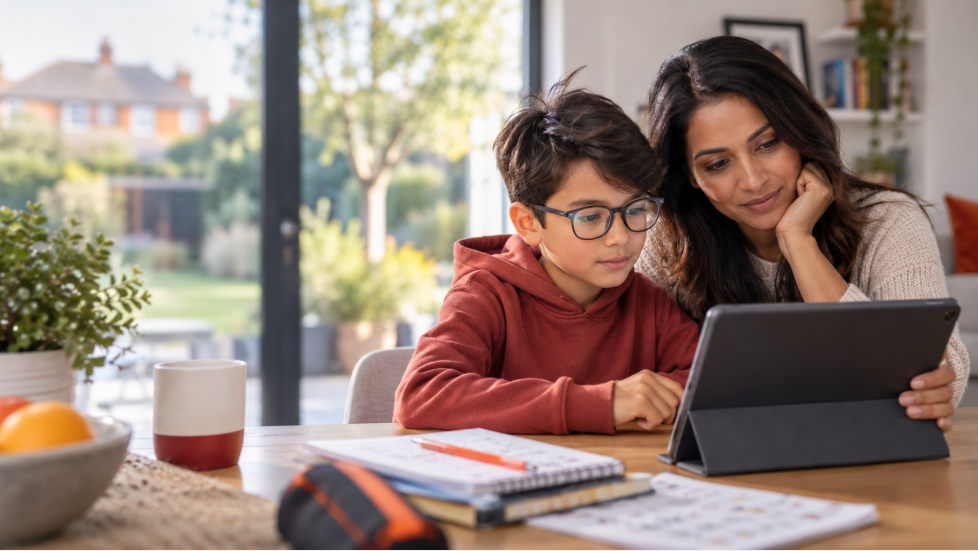
Now picture the same child indoors. Walls are flat and plain, the floor is flat, and almost everything sits between about thirty centimetres and three metres away, so the eye rarely reaches into the distance. The light is artificial and unchanging. Much of the time the scene is a static screen. As nourishment, this is thin and repetitive.
What we know for certain is that time outdoors protects children's eyes. Which features of the outdoor scene deliver that protection is still being worked out. The clearest example so far is fine detail. There is much less of it indoors than outdoors, so much less that one study likened it to a frosted lens,⁶ the kind used in experiments to make eyes grow too long. Contrast, movement and the colour of light are promising candidates that need more research in children.1
Why this idea matters
The visual diet is a more complete and more motivating way to think about prevention than simply telling families to use fewer screens or to go outside more. It explains why outdoors works so well, feeding a child's eyes far more variety than any indoor space can. And it reframes the goal. The aim is not to fear screens, but to make sure children are regularly fed the varied, full-distance, full-spectrum diet their eyes were built for.
The broad picture is already clear, even as the finer details are worked out, and the practical steps are simple.
A healthy visual diet for your family
Aim for two hours outdoors in daylight every day. The outdoor scene is the finest visual diet there is, full of detail, depth, contrast, movement and natural light all at once.
Choose varied, natural settings such as a park, a garden, a beach or woodland, where the eye is fed fine detail and a changing scene.
Indoors, bring in as much of that as you can. Open the windows for direct natural light, and give children real, textured, hands-on things to do rather than only flat screens.
Break up long stretches of reading and screen time. A few minutes looking out a window or stepping outside gives the eye the varied, detailed and distant view that a screen cannot.
Have your child's eyes checked regularly by an optometrist, particularly if myopia runs in the family.
Think of it as feeding the eyes well. Surrounded by flat walls and bright screens, letting children spend real time in the rich, changing world outside may be one of the simplest and most powerful things we can do for their sight.
References
Marcos S. Optical and visual diet in myopia. Investigative Ophthalmology & Visual Science. 2025;66(7):3. https://doi.org/10.1167/iovs.66.7.3
He M, Xiang F, Zeng Y, et al. Effect of time spent outdoors at school on the development of myopia among children in China: a randomised clinical trial. JAMA. 2015;314(11):1142-1148. https://doi.org/10.1001/jama.2015.10803
Rose KA, Morgan IG, Ip J, et al. Outdoor activity reduces the prevalence of myopia in children. Ophthalmology. 2008;115(8):1279-1285. https://doi.org/10.1016/j.ophtha.2007.12.019
Read SA, Collins MJ, Vincent SJ. Light exposure and eye growth in childhood. Investigative Ophthalmology & Visual Science. 2015;56(11):6779-6787. https://doi.org/10.1167/iovs.14-15978
Xiong S, Sankaridurg P, Naduvilath T, et al. Time spent in outdoor activities in relation to myopia prevention and control: a meta-analysis and systematic review. Acta Ophthalmologica. 2017;95(6):551-566. https://doi.org/10.1111/aos.13403
Flitcroft DI, Harb EN, Wildsoet CF. The spatial frequency content of urban and indoor environments as a potential risk factor for myopia development. Investigative Ophthalmology & Visual Science. 2020;61(11):42. https://doi.org/10.1167/iovs.61.11.42
About the author
John Nguyen is an Australian optometrist and the founder of Luxi Health, which develops daylight-tracking technology to encourage healthy daylight habits in children. He built Zoom Optics into a group of practices across Sydney, and writes and speaks internationally on myopia. He has a particular interest in the role of outdoor light and the wider visual environment in healthy eye development.


Comments