
A Conversation with Anthony Josephson: Choosing Glasses Frames for High Myopes

Updated: Mar 4
Understanding the Challenges of High Myopia
It’s something I’ve always struggled with. As a high myope, choosing glasses frames has never felt instinctive. I admire bold frames on other people, but whenever I try to go bold myself, I usually regret it. It doesn’t feel like me. Yet, I’m always impressed when someone else really owns the look and wears their glasses with confidence rather than apology.

Over the years, I’ve met Anthony Josephson several times at 100% Optical. His frame choices are confident, bold, and considered. Eventually, I asked him for advice, not just for myself, but for other high myopes who quietly find frame choice harder than it should be. Anthony is an optician at Maskell + Josephson Optometrists, and what follows reflects how these conversations actually happen in practice.
Common Mistakes in Frame Selection
One of the first things Anthony raised was a mistake he sees all the time. Frames are often selected based on how they look with 'plano' lenses (specialized lenses with 0.00 diopter power), sometimes with the help of friends or family who are focused entirely on aesthetics. The problem, he explained, is that “a frame that looks great on the shelf can behave very differently once a strong prescription is fitted.”
In his experience, high myopes are particularly vulnerable to this disconnect. “For high myopes, frame choice and lens choice are inseparable,” he said. “If the eyes sit too far from the centre of the lens, thickness increases. If the frame is too large or too square, the cosmetic outcome changes dramatically. Ignoring this is often why people end up disappointed, even when they’ve chosen something they liked at the outset.”
“With good frame selection, the thickness difference can be minimal,”
The Impact of Frame Shape on Lens Thickness
When we talked about lens thickness and the so-called iceberg effect, Anthony was clear that shape plays a far bigger role than most people realise. “Circular or softly rounded frames, with the eyes positioned centrally, tend to work best because they minimise the distance from the optical centre to the lens edge,” he explained. As frames become larger or more angular, and as the eyes move away from the centre, lens thickness inevitably increases.
There’s also a widespread assumption that plastic frames are automatically better for strong prescriptions because they hide lens edges. Anthony doesn’t fully agree. “It isn’t as simple as saying plastic is better than metal,” he said. “A well-chosen metal frame can look better than a thick plastic one if the selection is done properly.”
The Role of Lens Thickness and Material
The same principle applies to lenses. High-index, thinned lenses can make a real difference, but Anthony cautioned against assuming that the highest index is always the right answer. “With good frame selection, the thickness difference can be minimal,” he explained, “and higher index lenses can introduce other compromises, often to optical quality.” In many cases, he feels it’s better to invest in a better lens design rather than simply chasing the thinnest material available.
Building Confidence in Frame Selection
One of the most practical pieces of advice Anthony shared was about confidence when choosing frames. For anyone who wears contact lenses, he strongly recommends putting them in when trying frames on. “It allows you to see the frame for what it really is,” he said, “rather than relying on mirrors or other people’s opinions.”
That leads to a broader mindset shift that Anthony believes is important, even if it’s uncomfortable at first. “You’re highly myopic. You wear glasses. There’s no hiding it. So embrace it, find something that works with your face and your prescription, and you’ll be much happier wearing it.”
I’m still unlikely to go truly bold myself, but I can see why the people who look best in their glasses are often the ones who stop trying to minimise them.
Comfort and Distortion: Finding the Right Fit
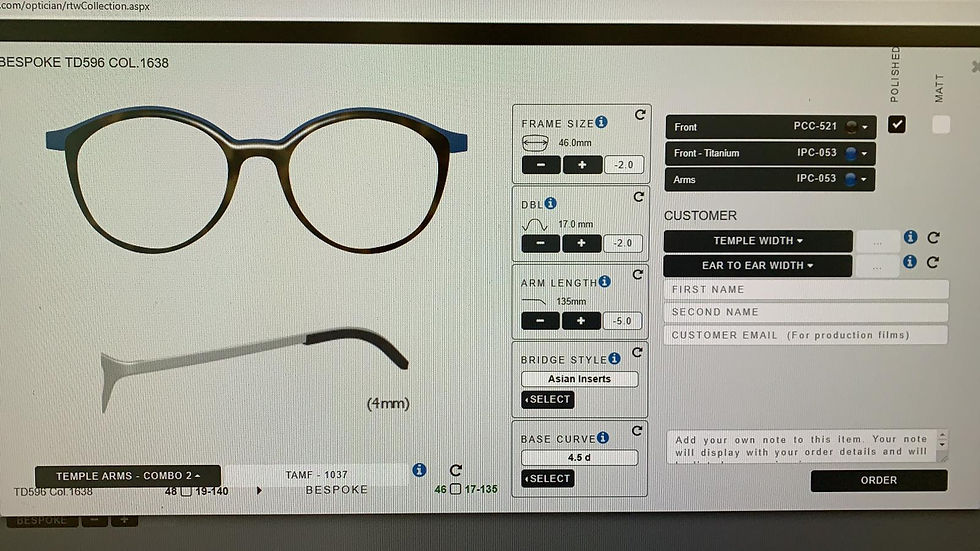
Comfort and distortion are another area where people often look for a simple fix. Anthony was clear that there isn’t one. “There’s no one style that works for everyone,” he said. What has changed, however, is the rise of bespoke and adjustable frames. “You may be able to adjust the frame slightly, or even thicken it to help hide lens thickness. Combined with more advanced lens designs, this can significantly improve comfort and visual quality for higher prescriptions."
Understanding Multifocal Lenses
When we discussed varifocals and bifocals, Anthony was refreshingly honest. “Every multifocal lens involves compromise,” he said. The aim is to understand how someone actually uses their eyes and choose the least frustrating compromise. “Sometimes one pair of glasses won’t do everything well,” he added, “and that should be accepted.”
“It’s important for everyone to wear sunglasses,”
The Importance of Sunglasses
Sunglasses were another area where Anthony was unequivocal. “It’s important for everyone to wear sunglasses,” he said, not just for UV protection but also to reduce glare and manage blue light exposure. This is one area where higher-quality lenses genuinely differ from cheaper alternatives.
Glasses for Highly Myopic Children - Myopia Control Lenses
For parents of highly myopic children, Anthony’s advice mirrors that for adults, with a few added considerations. “Consider all of the above,” he said, “but also factor in myopia control options when choosing lenses.” For sport and active lifestyles, contact lenses are often worth serious consideration.
The Cost of Quality Eyewear
Finally, we talked about cost. Anthony’s philosophy is simple. “Get the very best your budget can realistically stretch to,” he said. But just as importantly, “I don’t want people spending what they don’t have because they feel pressured.” A good optician, he believes, should explain what’s possible now, what sits beyond budget, and what might be worth considering next time, especially with interest-free payment plans now widely available.
Conclusion: Embracing Your High Myopia
I may never be someone who confidently wears bold frames, and I’m comfortable with that. But this conversation helped me understand why some choices work, why others don’t, and why the people who look most at ease in their glasses are rarely trying to hide behind them. For high myopes, frame choice doesn’t have to feel like a compromise. With the right guidance, it can be deliberate, personal, and something you feel quietly confident about getting right.



Comments